Coursera review (2026): what you get, what it costs, and who should skip it
Coursera is one of the best places online to earn a credential with a recognisable university or company name on it. It is also easy to overpay, and since August 2025 its free option works very differently. Here is everything you need to decide.

No affiliate links: Active Learning Site currently has no affiliate relationships. Links to platforms and sellers earn us nothing. Our disclosure.
credentialsbest for
Our verdict (editorial opinion)
Coursera is the strongest mainstream choice when a recognisable credential and a structured program matter to you, and when you will actually finish it. Pricing is confusing and billing mistakes are the most common complaint, so read the traps section before you pay. If you only want inspiration or one narrow tool skill, cheaper options fit better.
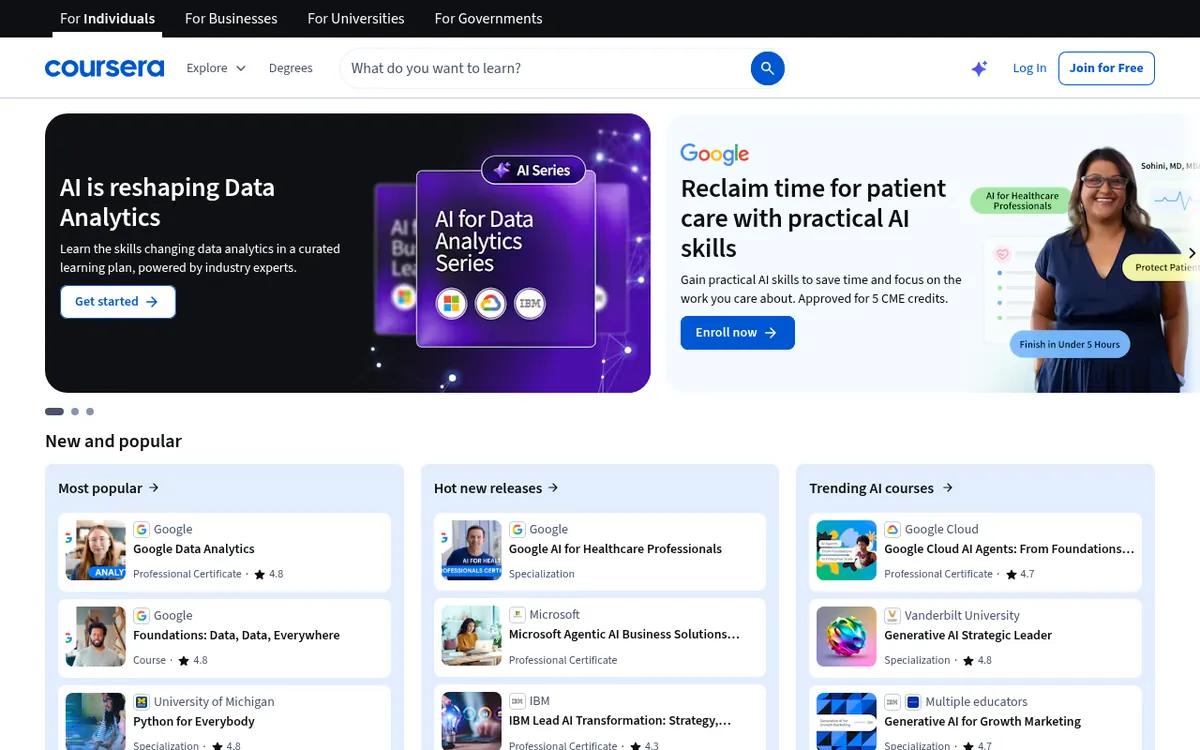
Last verified: 31 October 2026 · Research-based review (no hands-on testing claimed) · Prices shown are US list prices from official pages unless marked otherwise
The short version
- What it is: a platform that sells courses, Specializations, Professional Certificates and full degrees made by hundreds of universities and companies (Google, IBM, Meta, Stanford, Duke, Michigan and others).
- What it costs (US list, 31 Oct 2026): Coursera Plus is $59/month or $399/year, as shown on Coursera's own Plus page. Single programs are sold by monthly subscription or one-time payment, and degrees are priced separately by each university.
- The free option changed: in August 2025 Coursera replaced the old "audit" mode with a free preview of the first module of most courses. You can no longer watch a whole course free on most of the catalog.
- Refunds are narrow: the monthly Plus plan has a 7-day free trial, the annual plan has a 14-day money-back window, and Coursera gives no partial refunds.
- The certificate is not the prize: learners and hiring discussions agree that a certificate supports a CV but rarely gets you an interview on its own. The projects you build on the way matter more.
Who Coursera is for (and who should skip it)
Good fit
- Career changers aiming at an entry-level role (data analytics, IT support, UX, project management) who want a structured path
- People whose employer reimburses recognised credentials, or who want a university name on a certificate
- Learners who like deadlines, quizzes and graded assignments rather than loose videos
- People on a tight budget who qualify for financial aid
- Anyone exploring a full online degree, who can sample a partner university's teaching first
Poor fit
- Hobbyists who want short, inspiring lessons. MasterClass or Skillshare suit them better
- Developers who need one specific tool fast. A single well-reviewed Udemy course is usually cheaper and lets you keep it
- Anyone expecting a certificate alone to get them hired
- People who cannot commit regular weekly hours, because subscriptions keep billing while you stall
- Learners who need lots of human feedback, since most grading is automated or done by peers
What Coursera is, and what changed in 2025–2026
Coursera does not make most of its own content. Universities and companies build the courses, and Coursera hosts, sells and certifies them. That is why quality varies by partner: a Google or DeepLearning.AI program feels very different from an older university course that has not been refreshed in years.
Three changes since 2025 matter if you are reading older reviews:
- Audit was replaced by preview (August 2025). Coursera's own blog announced that the new course preview "replaces our audit experience". You get the first module of nearly every course free, graded assignments and the Coursera Coach AI assistant included where available, and later modules are locked. Some select courses offer "Full Course, No Certificate" instead. A preview can last up to six months. Many reviews still say "audit for free". That is out of date.
- Localized pricing. In the same announcement Coursera said it was rolling out regional pricing, so the price you see may differ from US prices.
- Coursera and Udemy are now one company. Coursera completed its combination with Udemy on 11 May 2026, and Udemy became a wholly owned subsidiary. For now the two still sell separately, with separate catalogs, accounts and refund policies. Don't assume a Udemy purchase carries over to Coursera or the other way round.
Every way to pay for Coursera, compared
The single most confusing thing about Coursera is that the same course can be bought four different ways. This table shows them side by side.
| Option | Price (US) | What you get | Refund / trial | Best for |
|---|---|---|---|---|
| Free preview | $0 | First module of most courses, graded work included; no certificate. Some courses: Full Course, No Certificate | n/a | Checking teaching style and level before paying |
| Single course (one-time) | Set per course | That course plus its certificate; 180 days to finish | See refund policy for the course | One course you will definitely finish |
| Specialization / Professional Certificate subscription | Set per program; third-party trackers report roughly $49–$79/month | That program only, billed monthly until you finish or cancel | Many start with a 7-day free trial | One credential, finished quickly |
| Coursera Plus Monthly | $59/month (official) | 10,000+ courses, Guided Projects, Specializations and most Professional Certificates; unlimited certificates | 7-day free trial; cancel anytime; no partial refunds | 1–6 months of focused study |
| Coursera Plus Annual | $399/year (official list; promos often lower) | Same catalog as monthly | 14-day money-back guarantee | Studying for 7+ months, or several programs |
| Online degree | Set by each university; often several thousand to $25,000+ | Accredited bachelor's or master's from the partner university | University terms apply | Degree seekers |
Prices vary by country (Coursera has introduced localized pricing), and promotions change often. Coursera has, for example, discounted the annual plan during November sales in past years. That is a reported pattern, not a promise. Check the current price on Coursera's official page before you buy. In India, Coursera's help center says only the monthly Plus option is available.
A rule of thumb: at list price, seven months of Plus Monthly ($413) costs more than one year of Plus Annual ($399). If you are sure you will study for seven months or more, annual is cheaper. Below that, monthly wins. Our Coursera Plus break-even calculator does this math for your own hours.
What Coursera Plus includes and excludes
Coursera's help center describes Plus as covering "over 90%" of the catalog: 10,000+ courses, Guided Projects, Specializations and Professional Certificates, with unlimited certificates. The exclusions are where buyers get caught:
- Degrees and for-credit courses are not included.
- MasterTrack and other university credit programs sit outside Plus.
- Certain Professional Certificates may be excluded. Check for the Coursera Plus badge or wording on the specific program page before you subscribe.
- Some partner-specific or enterprise content is not part of the consumer catalog.
Do the check in this order: open the exact program you want, confirm it says it is included with Coursera Plus, and only then start the trial. Use the trial week to open every course you bought Plus for.
Traps to avoid: double billing, renewals and lost access
Billing, not course quality, drives most negative Coursera reviews. Most of it is avoidable:
- Existing subscriptions are not cancelled when you buy Plus. Coursera's help center says this explicitly. If you were paying $49/month for a Google certificate and then buy Plus, you will pay for both until you cancel the old one. Check My Purchases and cancel every older subscription the day you upgrade.
- No partial refunds. Cancel in month 3 of an annual plan and you get nothing back. You keep access until the end of the paid period.
- The annual refund window is 14 days from the original payment. Day 15 is too late. Renewals of annual plans are not refunded, so set a calendar reminder about two weeks before the renewal date.
- Free trials convert automatically. The 7-day trial bills on day 8. Set a reminder for day 6.
- Access ends when you stop paying. After you cancel, content falls back to preview mode. Download your certificate PDFs and any notes or project files you want to keep while you still have access.
- Financial-aid applicants: don't start a free trial. Coursera's help pages warn that starting a trial or paying cancels a pending financial-aid application.
How to cancel Coursera and request a refund, step by step
To cancel a subscription (Plus or a program):
- Log in on a web browser and open your account menu → My Purchases (sometimes labelled Purchases or Subscriptions).
- Find each active subscription. Remember there may be more than one.
- Choose Cancel subscription and confirm, then look for the confirmation email.
- If you subscribed through the Apple App Store or Google Play, cancel in that store's subscription settings instead.
To request a refund on annual Plus (within 14 days): go to Purchases → Purchase History → Request refund. Coursera's help center says refunds take about 7–10 business days to appear, and your access switches to preview mode.
Is Coursera free? The preview and financial aid explained
Preview: for most courses you get the full first module, graded assessments included, but no certificate. For courses inside a Specialization or Professional Certificate, Coursera's help article says the preview shows course materials but locks graded assessments. Look for a small "Preview this course" link under the main enroll button. If it isn't there, that course doesn't offer a preview.
Financial aid: this is Coursera's most under-used benefit, and both the YouTube reviewer we watched and learner forums say many people don't know it exists. You apply from the course page ("Financial aid available"), answer questions about your circumstances and goals, and wait for a decision. Coursera's help pages put the review at roughly two weeks. Approved aid unlocks the course and certificate for free or at reduced cost. Apply course by course. While you wait, don't start a trial or pay, because that cancels the application.
Truly free courses: Coursera also keeps some "Community Impact" courses fully free (mental health, public health, refugee support and similar), according to the 2025 announcement.
Are Coursera certificates worth anything? The credential ladder
| Credential | Issued by | Typical length | How employers tend to see it |
|---|---|---|---|
| Course certificate | Partner university or company | 2–6 weeks | Minor CV line; shows initiative |
| Specialization certificate | Partner | 2–6 months | Useful if tied to a portfolio project |
| Professional Certificate (Google, IBM, Meta…) | The company | 3–8 months at part-time pace | Recognised name and an ATS keyword. Still rarely enough on its own for a job |
| Credit-eligible / MasterTrack | University | Months | Can count toward a degree at that university |
| Online degree | Accredited university | 1–4 years | A real degree, the same as on-campus at many partners |
Our reading of recent discussions on r/coursera, r/careerguidance and r/lifelonglearning is consistent: employers value demonstrable skills and projects over the certificate. Certificates may help a CV get through keyword filters or signal motivation in a career change, but posters who landed roles usually credit a portfolio, networking or prior experience alongside the certificate. Treat a Professional Certificate as a structured syllabus that forces you to build things, and put those things on GitHub, Tableau Public or a portfolio site.
College credit: some Coursera programs carry ACE credit recommendations, and some partner universities accept specific courses toward degrees. It is program-specific, so check the "credit" section of the program page and confirm with the institution that would accept it.
Course quality: how to tell a good Coursera course from a stale one
- Check the partner and the instructor. Company programs (Google, IBM, Meta, DeepLearning.AI) are usually refreshed more often than older university MOOCs.
- Look at the number of ratings, not just the stars. 4.8 from 200,000 learners means more than 4.9 from 300.
- Read recent reviews. Look for comments about outdated software versions or broken labs.
- Check how assignments are graded. Peer-graded assignments can stall if few people are taking the course.
- Use the free preview to do Module 1's graded quiz. If it feels too easy or too hard, you've saved a month's fee.
Pros and cons
What we like
- Content from recognisable universities and companies, with partner-branded certificates
- Structured programs with deadlines, graded work and capstone projects
- Clear paths into entry-level roles via Professional Certificates
- Financial aid can make courses free or cheaper
- The free first-module preview now includes graded work, so you can genuinely test a course
- Coursera Plus can be strong value if you finish several programs
- Real accredited degrees are available on the same platform
What to watch out for
- Pricing is confusing: four ways to buy the same course
- Old subscriptions aren't auto-cancelled when you buy Plus, so double billing is common
- No partial refunds; annual refund window is only 14 days
- The old free full-course audit is gone for most courses
- You lose access to materials when you stop paying
- Quality and freshness vary by partner; some courses are theory-heavy or dated
- Little human feedback; peer grading can be slow or inconsistent
What learners say
| Source | Recurring praise | Recurring complaints |
|---|---|---|
| YouTube: a reviewer with 6+ years on Coursera (video HiaNuL3gUiA) | Credibility of partners, structured curriculum, flexibility, financial aid many people miss | Confusing pricing that adds up over months; losing access after the subscription ends; some theory-heavy or dated courses; only worth paying for if you use it |
| Reddit (r/coursera, r/careerguidance, r/lifelonglearning) | Good structured introduction to a field; useful for keyword-matching CVs | Certificates alone rarely lead to interviews; employers want projects and experience |
| Gartner Peer Insights (enterprise buyers) | Breadth of catalog; strong technical content from big tech partners | Uneven quality outside flagship programs |
| Trustpilot (consumer reviews) | Content quality when it works | Dominated by billing, renewal and support complaints. Trustpilot showed 1.3/5 from 1,435 reviews when we loaded it on 31 Oct 2026; scores move, so check the live page |
Trustpilot reviews skew toward people with billing problems, so its low score mainly reflects the subscription traps above, not teaching quality. Gartner's 4.4/5 from enterprise buyers reflects a different audience. Neither alone tells you whether a specific course is good. The course's own recent reviews and its preview do.
Mobile app and offline learning
Coursera has iOS and Android apps with downloadable lecture videos for offline viewing, which is handy for commutes. Graded quizzes and assignments need a connection to submit, and some labs (coding notebooks, cloud labs) only work on a desktop browser. If you mostly learn on a phone, prefer video-and-quiz courses over lab-heavy programs.
Coursera vs Udemy vs LinkedIn Learning vs edX vs Skillshare
| Platform | Model | Typical cost (US) | Credential | Keep access? | Refund |
|---|---|---|---|---|---|
| Coursera | Plus subscription, per-program subscription, one-time course, degrees | $59/mo or $399/yr Plus | Partner-branded certificates; real degrees | No, ends with subscription (single courses: 180 days) | Annual Plus: 14 days; no partial refunds |
| Udemy | Buy courses one by one, or Personal Plan subscription | Frequent sales on single courses; Personal Plan varies by region | Certificate of completion (not accredited) | Purchased courses: lifetime access (while the course is licensed) | Eligible courses: 30 days; subscriptions generally none |
| LinkedIn Learning | Via LinkedIn Premium, employer, university or library only | Premium Career US$39.99/mo or US$239.88/yr | Completion certificate on your profile | No | Premium: may be refundable within 7 days if unused |
| edX | Per-course verified track, programs, degrees | Per course | University certificates | Varies by course | Per edX policy |
| Skillshare | Annual subscription | US$167.88/yr | None accredited | No | 7-day trial: 48-hour one-time refund if unused |
See the full Coursera vs Udemy comparison and our best Coursera alternatives.
Alternatives, with honest trade-offs
- edX: the closest like-for-like (university courses and degrees). The catalog differs, so compare the specific program.
- Udemy: cheaper for a single practical skill, and you keep purchased courses. No recognised credential.
- LinkedIn Learning: free for many people via a library card or employer. Shorter, shallower courses.
- Free routes: freeCodeCamp, Khan Academy, MIT OpenCourseWare and official vendor training (Google Skillshop, Microsoft Learn) teach a lot for nothing. There is no Coursera-style certificate, but you get the same skills.
How to get the most out of Coursera
- Finish the free preview of Module 1 before paying anything.
- Budget real hours. Programs list an estimated pace (for example "10 hours a week"). If you can only manage half, double the months, and the cost.
- If you'll take one program for under seven months, pay monthly. Switch to annual only when you know you'll keep going.
- Cancel old program subscriptions the same day you buy Plus.
- Build something public from every course, such as a dashboard, repo or case study.
- Use active recall and spaced practice instead of re-watching videos. Our active learning guide explains how.
How we researched this review
We have not bought or used Coursera for this review. It is built from Coursera's own pricing, help-center and terms pages (read on 31 October 2026), publicly posted learner reviews and discussions, YouTube reviews by long-term users (transcripts read in full and paraphrased below), and the pages that currently rank for this topic, which we checked so we could cover what they miss. We note where a figure comes from a third party rather than the official site. We do not give star ratings or numeric scores, because we have not tested the product hands-on.
We could not capture live checkout screenshots, so we cannot show what checkout looks like in your country. Prices vary by region and change with promotions. Check the current price on the official page before you pay.
Coursera FAQ
How much does Coursera cost in 2026?
On 31 October 2026 Coursera's Plus page listed Coursera Plus at $59 per month or $399 per year (US). Individual Specializations and Professional Certificates are sold by monthly subscription (third-party trackers report roughly $49–$79 a month), single courses can be bought once with 180 days of access, and degrees are priced by each university. Prices vary by region, so check the official page.
Is Coursera free?
Partly. Most courses offer a free preview of the first module, including graded work, but no certificate. Some courses offer Full Course, No Certificate, a few Community Impact courses are fully free, and financial aid can make paid courses free for eligible learners.
Can you still audit Coursera courses for free?
Not in the old form for most courses. In August 2025 Coursera announced that its new course preview replaces the audit experience. The preview gives you the first module free, and later modules are locked unless you pay or receive financial aid.
Does Coursera have a free trial?
Yes. Coursera Plus Monthly and many Specialization or Professional Certificate subscriptions start with a 7-day free trial that converts to a paid subscription unless you cancel. The annual plan has a 14-day money-back guarantee instead of a trial.
Can I get a refund from Coursera?
Annual Coursera Plus can be refunded within 14 days of the original payment. Coursera does not give partial refunds, so cancelling later just stops the next charge. Refunds take about 7–10 business days to process.
How do I cancel Coursera?
On a web browser, open My Purchases, find each active subscription and choose Cancel. If you bought through Apple or Google, cancel in that app store. Cancel any older program subscriptions separately, because buying Coursera Plus does not cancel them.
Is Coursera Plus worth it?
It is worth it if you'll finish enough paid study to beat paying per program, roughly seven or more months of study at list prices, or two or more programs in a year. Use our Coursera Plus break-even calculator to check with your own hours.
Are Coursera certificates recognized by employers?
Employers recognise the partner names (Google, IBM, universities), but a certificate is a supporting signal, not a qualification. Hiring discussions consistently say projects, a portfolio and experience matter more.
Is Coursera accredited?
Coursera itself is not a university. Its online degrees are awarded by accredited partner universities. Most other certificates are non-credit, although some programs carry ACE credit recommendations or count toward a partner's degree.
Is Coursera legit?
Yes. Coursera is a publicly listed company (ticker: COUR) that works with hundreds of universities and companies. Legitimacy is not the issue. Picking the right program and managing billing is.
Do I keep access after cancelling Coursera?
You keep access until the end of the period you paid for. After that, the content drops back to preview mode. Download your certificates and any materials you want to keep before access ends.
Can I get financial aid on Coursera?
Many courses offer financial aid. Apply on the course page, and expect a decision in about two weeks. Don't start a free trial or pay while the application is pending, because that cancels it.
How long does a Google Professional Certificate take?
Coursera lists an estimated pace on each program page, typically several months at around 10 hours a week. Check the page for the specific certificate and adjust for the hours you can really study.
Coursera or Udemy: which is better?
Coursera is better for recognised credentials and structured programs. Udemy is better for a single practical skill at a low sale price that you keep. Both are now owned by the same company but still sold separately.
What happened between Coursera and Udemy?
Coursera completed its combination with Udemy on 11 May 2026, and Udemy became a wholly owned subsidiary. The two platforms still have separate catalogs, accounts and policies.
Does Coursera work offline?
The Coursera mobile apps let you download lecture videos for offline viewing. Quizzes, assignments and labs need a connection, and some labs only work in a desktop browser.
Is Coursera good for beginners?
Yes, especially beginner-level Professional Certificates designed for people with no experience. Use the free preview to confirm the level before paying.
Does Coursera give college credit?
Some programs carry ACE credit recommendations, and some partner universities accept specific Coursera courses toward their degrees. Check the program page and confirm with the institution.
Sources and last verified
Last verified: 31 October 2026. Official pages were read on that date. Third-party figures are attributed and dated where we cite them.
- Coursera Plus page ($59/month; $399/year with 14-day money-back guarantee)
- Coursera blog: new course preview replaces audit (8 Aug 2025)
- Coursera help: How to preview a course
- Coursera help: Coursera Plus (coverage, trial, India, existing subscriptions)
- Coursera help: refund policy
- Coursera help: paying for individual courses (180 days)
- Coursera help: apply for financial aid
- Coursera investor news: combination with Udemy completed (11 May 2026)
- Gartner Peer Insights: Coursera — enterprise reviews
- YouTube: Is Coursera Worth It in 2026? (6+ year user) — creator may use affiliate links
- Reddit r/coursera: are certificates worth it?
- Reddit r/careerguidance discussion
- Trustpilot: Coursera — score changes daily
Ready to try Coursera?
Start with the free preview or the 7-day Plus trial, and set a reminder before it bills.
Visit Coursera → See Coursera Plus →